
The Art and Science of Duì Yào: Unveiling Biochemical Synergies
Here I dive into the fascinating world of botanicals and one of my favorite parts of traditional medicine, exploring the intricate balance between ancient wisdom and modern scientific understanding. This article spotlights Duì Yào (对药), a unique practice within Traditional Chinese Medicine (TCM) that exemplifies the profound art and science of combining botanicals. It’s a class I used to teach and hope to offer it again as a continuing education module. And maybe a book…
Duì Yào, often translated as “paired herbs” or “dyadic medicinals,” refers to the strategic combination of two specific herbs to achieve a synergistic therapeutic effect. This practice goes beyond simply mixing ingredients; it’s about understanding the subtle interplay of their individual properties to create a more potent and balanced outcome than either herb could achieve alone. What’s truly captivating is how contemporary biochemical research is beginning to unravel the scientific basis behind these age-old pairings.
The Art of Pairing: More Than the Sum of Its Parts
At its heart, Duì Yào is an art form honed over centuries of empirical observation and clinical experience. TCM practitioners meticulously select pairs of herbs based on their energetic properties, flavors, actions, and the specific disease patterns they aim to address. The goal is often to:
- Enhance Efficacy: One herb may boost the primary therapeutic action of the other.
- Mitigate Toxicity/Side Effects: A second herb can be used to neutralize or reduce the undesirable effects of the first.
- Broaden Therapeutic Scope: The combination can target multiple aspects of a complex condition.
- Guide Actions to Specific Areas: Certain pairings can help direct the medicinal effects to a particular organ or part of the body.
Unveiling the Science: Biochemical Relationships and Synergies
Very often Duì Yào forms the basis of classic formulas:
Xiao Yao San is an example of a formula that contains a harmonizing Duì Yào pair, that both reduces excess and nourishes deficiency. Xiao Yao’s Chai Hu (cool and acrid) soothes the Liver, and Bai Shao (sour) nourishes the blood. Liver Yang can benefit from the coolness of Chai Hu to keep it from overheating and creating Liver depression. There are other herbs in the formula too.
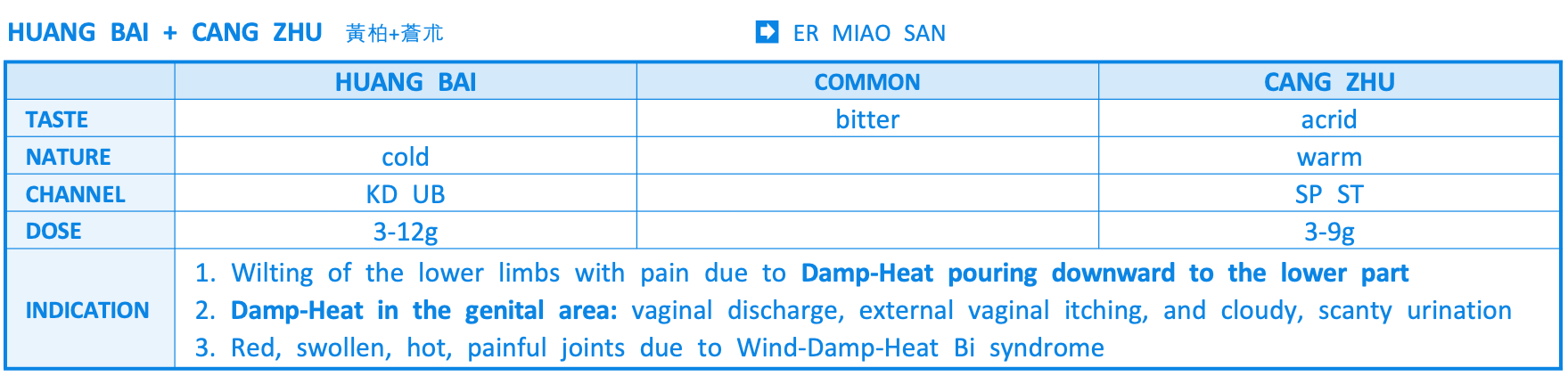
Er Miao San is a formula comprised of just two herbs, Huang Bai and Cang Zhu. Huang Bai clears heat and dries damp but is bitter and cold. Cang Zhu harmonizes because it is spicy, warm, and able to dry dampness. These botanicals used as a Duì Yào pair, clear heat with swelling and pain, in conditions such as rheumatic eczema, or with gout and arthritis in the lower part of the body.
Modern scientific inquiry is providing compelling evidence for the biochemical underpinnings of Duì Yào. Researchers are using advanced analytical techniques to identify the active compounds within these herbal pairs and understand how they interact at a molecular level.
Here are some fascinating examples of the biochemical relationships and synergies at play:
- Pharmacokinetic Modulation: One herb might influence the absorption, distribution, metabolism, or excretion of active compounds from its paired herb. For instance, compounds in one herb could inhibit enzymes that break down the active ingredients of another, thus increasing its bioavailability and therapeutic window.
- Pharmacodynamic Synergism: This is where the active compounds from two herbs exert their effects through different but complementary mechanisms, leading to a greater overall therapeutic outcome. For example, one herb might target inflammation, while its partner addresses pain perception, offering a more comprehensive relief for inflammatory pain.
- Multi-Target Approach: Many diseases, especially chronic ones, involve complex pathological pathways. Duì Yào often employs herbs with diverse chemical constituents that can simultaneously modulate multiple targets within these pathways. This multi-target approach often proves more effective than single-compound drugs, which typically focus on one specific target.
- Detoxification and Protection: Certain Duì Yào pairs are specifically designed to reduce toxicity or protect against adverse reactions. This can involve one herb enhancing the body’s natural detoxification pathways, or providing antioxidant protection against cellular damage induced by the other herb’s active compounds.
- Enhanced Solubility and Stability: In some cases, compounds from one herb can improve the solubility or stability of active ingredients from its paired herb, making them more available for absorption and utilization by the body.
Consider a classic Duì Yào example
One common pairing is Huang Qi (Astragalus membranaceus) and Dang Shen (Codonopsis pilosula). Traditionally, this pair is used to tonify Qi (vital energy) and strengthen the spleen and lungs.
- Huang Qi is rich in astragalosides and polysaccharides, known for their immunomodulatory, anti-inflammatory, and antioxidant properties.
- Dang Shen contains saponins and polysaccharides that contribute to its adaptogenic and immune-enhancing effects.
From a biochemical perspective, studies suggest that combining these two herbs may lead to enhanced immune regulation, improved energy metabolism, and potentially better absorption of their respective active compounds, leading to a more robust “Qi tonifying” effect.
The Future of Duì Yào Research
As scientific tools become more sophisticated, we anticipate even deeper insights into the biochemical intricacies of Duì Yào. Proteomics, metabolomics, and network pharmacology are powerful approaches that can map out the complex interactions between herbal compounds and biological systems. This research not only validates ancient wisdom but also opens doors for the development of new, highly effective, and personalized herbal formulations.
Duì Yào stands as a testament to the profound understanding of nature’s pharmacy cultivated over millennia. By bridging the gap between traditional knowledge and modern science, we can unlock the full potential of these powerful plant synergies for health and healing.
We hope you enjoyed this exploration into the fascinating world of Duì Yào. Stay tuned for more!

Author
Dr Arno Kroner
OMD LAc IFMCP