Integrative Recovery: Science and Wisdom for the Post Marathon Body & Mind
Completing 42.2km is a profound physiological and psychological event that pushes the human system into a state of “controlled trauma.” To recover effectively, we must look beyond basic rest and address the complex biochemical, renal, and neurological shifts that occur. By merging the precision of Functional Medicine with the holistic depth of Traditional Chinese Medicine (TCM), and tempering it with the hard-earned perspective of an ultrarunner, we can create a roadmap for total systemic restoration. Don’t miss my recent article about Branch Chain Amino Acids and their role in endurance.
The Psychological Transition: Integration and the “Post-Race Blues”
The finish line provides an immediate dopamine surge, but the days following often bring a psychological “crash.” From a functional perspective, this is a neurochemical recalibration; in TCM, it is a sudden dispersal of Shen (spirit/consciousness) after intense focus.
- Dopamine Depletion & The Void: You have spent months oriented toward a single goal. When that goal is removed, and the endorphin high fades, many runners experience “post-marathon blues.” This is a physiological state where neurotransmitter receptors down-regulate.
- The “Shen” Grounding: Intense endurance events can “scatter” the Shen. To integrate the achievement, use grounding practices like journaling the race experience or restorative breathwork. This helps move the experience from a high-stress “survival” memory into a consolidated “success” memory.
- Cognitive Reframing: Instead of viewing the week after as “doing nothing,” reframe it as “active rebuilding.” This shifts the mindset from loss of fitness to the gain of resilience.
Metabolic Restoration: The Glycogen “Refill”
A marathon is essentially a journey into glycogen bankruptcy. You have depleted the glucose stores in your muscles and exhausted the liver’s ability to regulate systemic energy.
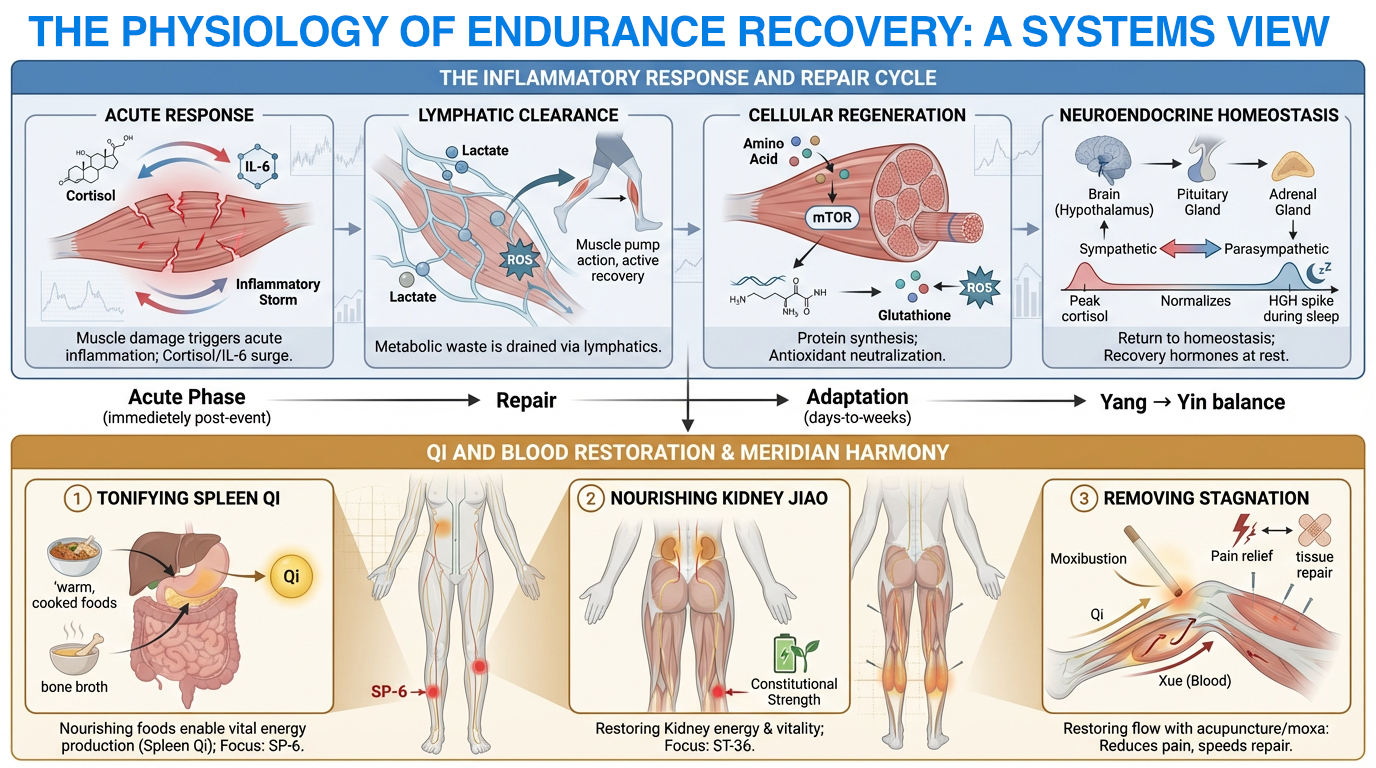
- The Biphasic Refuel: In the first 60 minutes, the body is a sponge. While high-GI carbs are essential here, the subsequent 24 hours require Spleen Qi support. In TCM, the Spleen is responsible for “transformation and transportation.” If we overwhelm it with cold, raw, or “damp” foods, we hinder the insulin-dependent phase of glycogen resynthesis.
- The Protein Synergy: Functional medicine highlights that co-ingesting protein with carbohydrates accelerates glycogen storage. From an integrative lens, this “tonifies the Blood,” providing the building blocks for muscle repair while replenishing the fuel tank.
Renal Integrity: The Kidney’s Filtration Burden
From a clinical perspective, the kidneys bear a massive load. Reduced renal blood flow during the race, combined with the “debris” from muscle breakdown (myoglobin), can stress the filtration system.
- Glomerular Filtration & Myoglobin: Functional medicine monitors the risk of “exertional rhabdomyolysis.” When muscle fibers break down, they release myoglobin, which can be toxic to the renal tubules. Post-race hydration isn’t just about thirst; it’s about “flushing” the kidneys to prevent tubular obstruction.
- The Kidney as the “Root of Life”: In TCM, the Kidneys store Jing (vital essence). A marathon is a massive withdrawal from this “inheritance.” Supporting the kidneys involves precise electrolyte balance—specifically magnesium and potassium—to assist the sodium-potassium pump and reduce renal workload.
Quelling the Inflammatory Storm
The soreness you feel is a systemic immune response. Mechanical stress triggers a surge in Interleukin-6 (IL-6) and causes neutrophils to infiltrate muscle tissue to clear “cellular debris.”
- Managing the Cytokine Cascade: While inflammation is necessary for adaptation, an unchecked “cytokine storm” leads to systemic exhaustion. We use antioxidants (like curcumin or tart cherry) to neutralize excessive Reactive Oxygen Species (ROS).
- Moving the Stagnation: TCM posits that “where there is no flow, there is pain.” This is Blood Stasis. Instead of complete immobilization, we utilize Active Recovery. Gentle walking or swimming acts as a lymphatic pump, physically moving metabolic waste out of the tissues.
The Integrative Recovery Timeline
|
Stage |
Focus |
Action & Mechanism |
|
The Golden Hour |
Homeostasis |
Isotonic hydration to protect kidneys; high-GI carbs; dopamine grounding. |
|
Evening (0–12h) |
Thermal Regulation |
Warm, cooked foods (congee/broth) to support Spleen Qi; emotional decompression. |
|
Days 1–3 |
Inflammation Control |
Acupressure (ST-36) to boost Qi; targeted anti-inflammatories; monitoring urine. |
|
Days 4–7 |
Tissue Remodeling |
Myofascial release; light walking to clear Blood Stasis; goal-setting for the next phase. |
The Ultrarunner’s Final Wisdom: Listen to the “Whispers”
Scientific markers like Heart Rate Variability (HRV) and Creatinine levels are invaluable, but they must be paired with internal awareness. In the weeks following a marathon, the body is in a state of “Open Window”—immunity is lower, and the “Empty Heat” of inflammation can linger.
True recovery isn’t about how fast you can get back to training; it’s about how thoroughly you can rebuild. By honoring the biochemical pathways of glycogen, cytokines, and renal filtration while nourishing the Qi, Jing, and Shen, you ensure that the marathon doesn’t just leave you depleted—it leaves you evolved.